
 EN
EN
Washer Functionality: Its Role in Secure Connections
In fastener engineering, the washer is one of the most underestimated components. It is a small flat disc — or sometimes a shaped ring — that sits between a bolt head or nut and the surface being joined. On the surface, it looks simple. In practice, the difference between choosing the right washer and the wrong one can determine whether a bolted joint holds under load, resists vibration, or survives years of outdoor exposure without corroding.
This article covers how a washer works, why it matters to connection security, the main types available, and how material and standard selection affect performance in real applications.
What a Washer Actually Does
A washer serves four core mechanical functions in a bolted or screwed connection:
- Load distribution: A bolt head or nut concentrates clamping force over a small contact area. A flat washer spreads that force across a wider surface, reducing stress on softer materials like wood, plastic, or aluminum and preventing the fastener from sinking in under load.
- Surface protection: Washers prevent the rotating bolt head or nut from scratching, gouging, or galling the workpiece surface during tightening, especially on painted, coated, or finish-critical surfaces.
- Alignment and spacing: Certain washer types compensate for oversized holes, maintain specific clearance dimensions, or provide a level bearing surface where the substrate is angled or uneven.
- Vibration and loosening resistance: This is where washer design diverges significantly. Standard flat washers do little to prevent loosening, but lock washers and spring washers introduce mechanical resistance that fights the tendency of fasteners to back out under cyclical loads or vibration.
These functions are the starting point for correct washer selection. The question is not just "do I need a washer?" — it is "what function does the washer need to perform in this joint?"
Main Types of Washers and Their Functions
Flat Washers
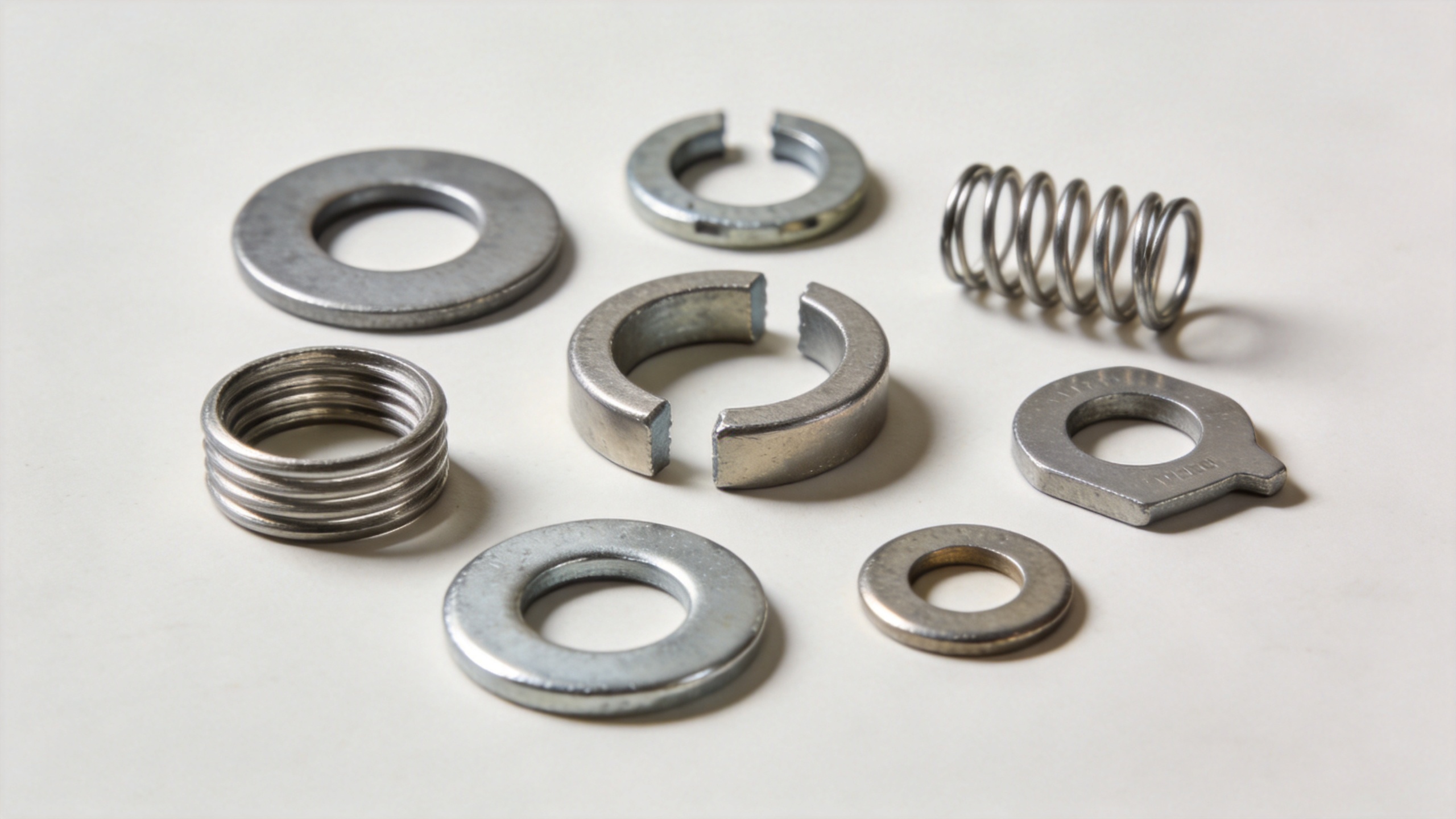
Flat washers, such as those conforming to DIN 125 or ISO 7089, are the most widely used. They are available in a broad range of inner diameters, outer diameters, and thicknesses to match standard fastener sizes. Their primary role is load distribution and surface protection. In general hardware, construction, and consumer product assembly, a standard flat washer in the correct size will satisfy most requirements.
One practical mistake is assuming any flat washer will do. If the outer diameter is too small, load distribution is insufficient. If the inner diameter is too large, the washer may tilt under load rather than bearing flat. Selecting washers that match the bolt class and application standard — not just the nominal bolt size — gives more predictable results in demanding joints.
Lock Washers
Split lock washers are helical-shaped split rings. When a joint is tightened, the two cut ends of the ring are compressed flat, storing spring energy and exerting an axial force that increases friction between the fastener and the mating surface. This friction resists loosening caused by vibration or cyclical loading. Split lock washers are commonly used in automotive assemblies, machine components, and any application where vibration is present and maintenance intervals are long.
To set realistic expectations: lock washers add meaningful resistance to loosening compared to no washer at all, but for highly dynamic applications, thread-locking compounds or flanged fasteners designed for vibration resistance may be more reliable. Lock washers work well in moderately dynamic environments where a cost-effective solution is preferred.
Spring Washers
Spring washers — including Belleville (disc spring) washers and wave washers — operate differently from split lock washers. They maintain a defined axial spring force that compensates for small amounts of joint relaxation, thermal expansion, or differential movement. Belleville washers are commonly specified in precision mechanical assemblies, electrical connections, and applications where maintaining preload over time is critical. They can be stacked in series or parallel to adjust the spring rate and deflection range.
Fender Washers and Penny Washers
Fender washers have an oversized outer diameter relative to the inner hole. This makes them effective at distributing load over a large area, particularly in thin sheet materials or where holes are slightly oversized. They are commonly used in construction, automotive body panels, and furniture assembly.
Star Washers and Toothed Lock Washers
Internal and external toothed (star) washers have serrated edges that bite into both the fastener and the substrate under clamp load, providing electrical continuity and mechanical loosening resistance. These are frequently used in electrical equipment and electronics where grounding continuity across the joint is required in addition to mechanical holding.
Material and Finish Selection
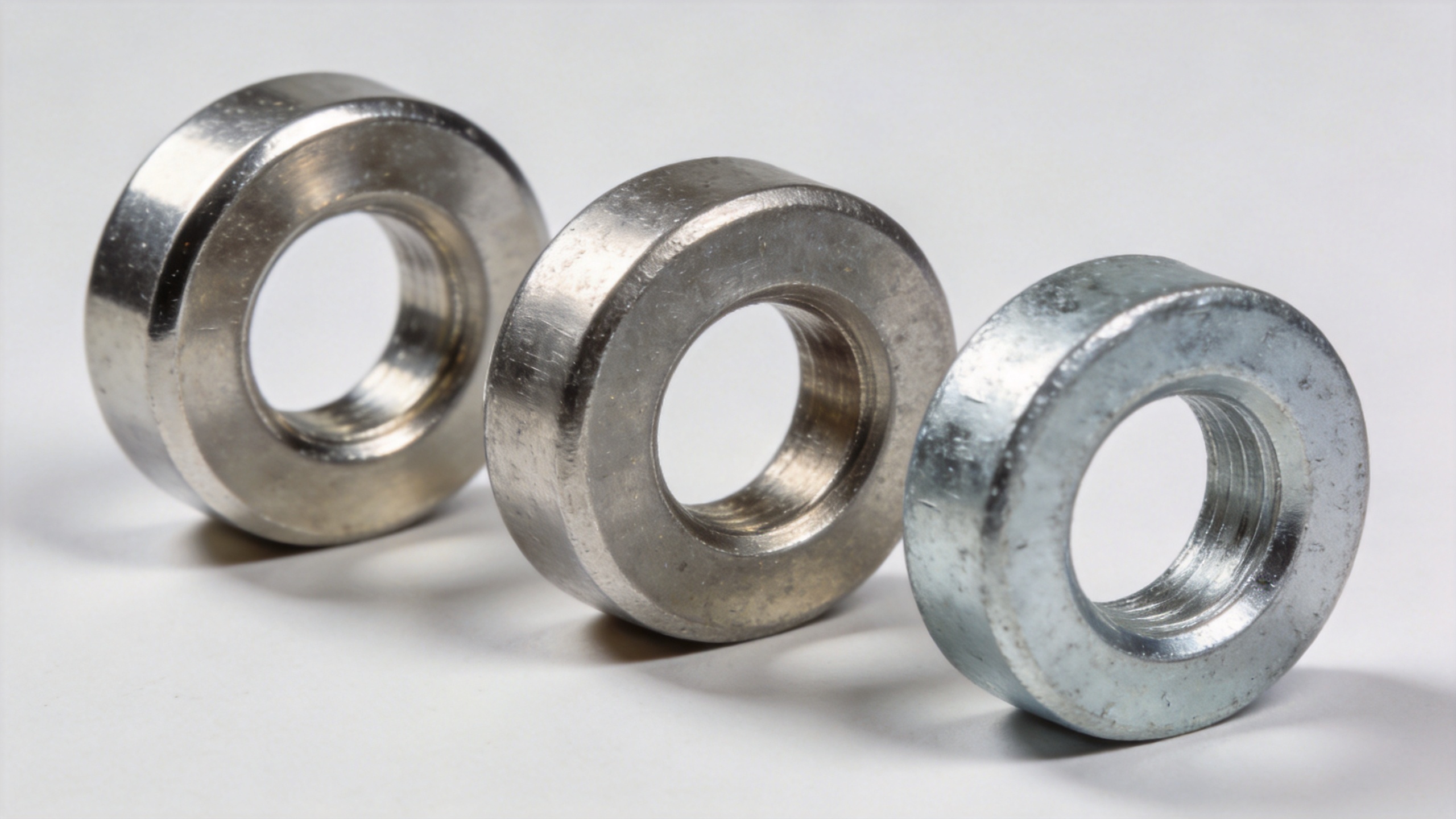
The material of a washer must match both the mechanical demands and the environmental conditions of the application. The most common options are:
- Carbon steel (zinc plated or galvanized): Cost-effective and widely available. Zinc plating provides basic corrosion resistance for indoor or light outdoor use. Hot-dip galvanizing provides heavier zinc coverage for outdoor or construction applications. Carbon steel washers conforming to DIN or ISO standards are the default choice for most general fastening applications.
- Stainless steel (A2 or A4): A2 (304 grade) offers good corrosion resistance for outdoor and food-contact applications. A4 (316 grade) adds molybdenum for superior resistance in marine, chemical, or coastal environments. Stainless steel washers are commonly used wherever the bolt and nut are also stainless, to avoid galvanic corrosion from mixed metals.
- Aluminum and brass: Used in specialized applications where weight reduction is critical or where specific electrical or aesthetic properties are needed. Aluminum washers are typical in aerospace and lightweight structural assemblies. Brass is used in plumbing fittings, decorative hardware, and electrical connectors.
A consistent oversight in procurement is treating washers as commodity items and mismatching materials with the fastener or substrate. Mixing carbon steel washers with stainless steel bolts in outdoor environments, for example, can accelerate corrosion at the contact point. Matching the washer material — and its surface treatment — to the overall fastener system avoids this.
Standards and Quality
Washers for industrial and construction use are produced to defined standards. DIN 125 and ISO 7089 cover standard flat washers. ISO 7090 and DIN 126 cover chamfered flat washers for precision applications. DIN 6916 applies to high-strength flat washers used in structural bolting. For lock washers, DIN 127 covers split lock washers.
Standards specify dimensional tolerances, material grades, hardness ranges, and surface finish requirements. Specifying the correct standard during procurement reduces the risk of receiving undersized, soft, or dimensionally inconsistent washers, a problem that is difficult to detect by visual inspection alone. In commercial hardware distribution, washers packaged with the relevant standard clearly marked give procurement teams a reliable basis for quality comparison across suppliers.
Selecting the Right Washer for the Application
A practical way to frame washer selection is to ask three questions:
- What is the load condition? Static or dynamic? High clamp load or low? If the joint experiences vibration or cyclical loads, a standard flat washer is likely insufficient on its own.
- What is the environment? Indoor, outdoor, coastal, chemical? Carbon steel with zinc plating works indoors. Stainless steel A4 suits marine or aggressive environments. Galvanized is appropriate for outdoor construction.
- What is the substrate? Hard steel, soft aluminum, wood, plastic? Harder substrates tolerate smaller OD washers. Softer substrates benefit from larger OD fender or flat washers to spread the load.
For many standard applications, a correctly sized flat washer in the right material is all that is needed. For joints with vibration exposure, a split lock washer or a Belleville washer adds meaningful resistance to loosening without significant cost increase. For precision assemblies or connections that must maintain consistent preload over time, a spring washer or Belleville stack is worth specifying.
Conclusion
The washer is a functional component, not an afterthought. Whether the goal is load distribution, surface protection, vibration resistance, or maintaining preload, there is a washer type and material specification suited to the task. Taking a few minutes to match the washer to the application rather than defaulting to whatever is on hand, is consistently one of the lower-cost decisions that improves joint reliability. For hardware distributors and procurement teams sourcing across a wide range of fastener applications, stocking a thoughtful range of flat, lock, and spring washers in the right materials and standards makes that match easy to achieve.
 Hot News