 EN
EN
OEM Packaging Evaluation: Aligning Business Goals
When sourcing hardware fasteners for retail or supermarket channels, the product itself is only part of the equation. OEM packaging — the custom-designed packaging that carries your brand and meets your retailer's shelf requirements — often determines whether a product line succeeds on the floor or sits in a warehouse. Yet many buyers evaluate OEM packaging based on price alone, without a structured framework that connects packaging decisions to their actual business goals.
If you've had a shipment rejected at the loading dock because the blister pack dimensions didn't match a planogram, or watched a promising fastener line underperform because the packaging failed to communicate value, you already know the cost of misaligned decisions. A clear evaluation process prevents most of these problems before they happen.
Why OEM Packaging Decisions Often Miss Business Targets
The most common mistake in OEM packaging evaluation isn't choosing the wrong material. It's starting with the wrong question. Buyers often ask "What's the lowest cost per unit?" when they should be asking "What packaging format will get this product stocked, displayed, and sold in my target channel?"
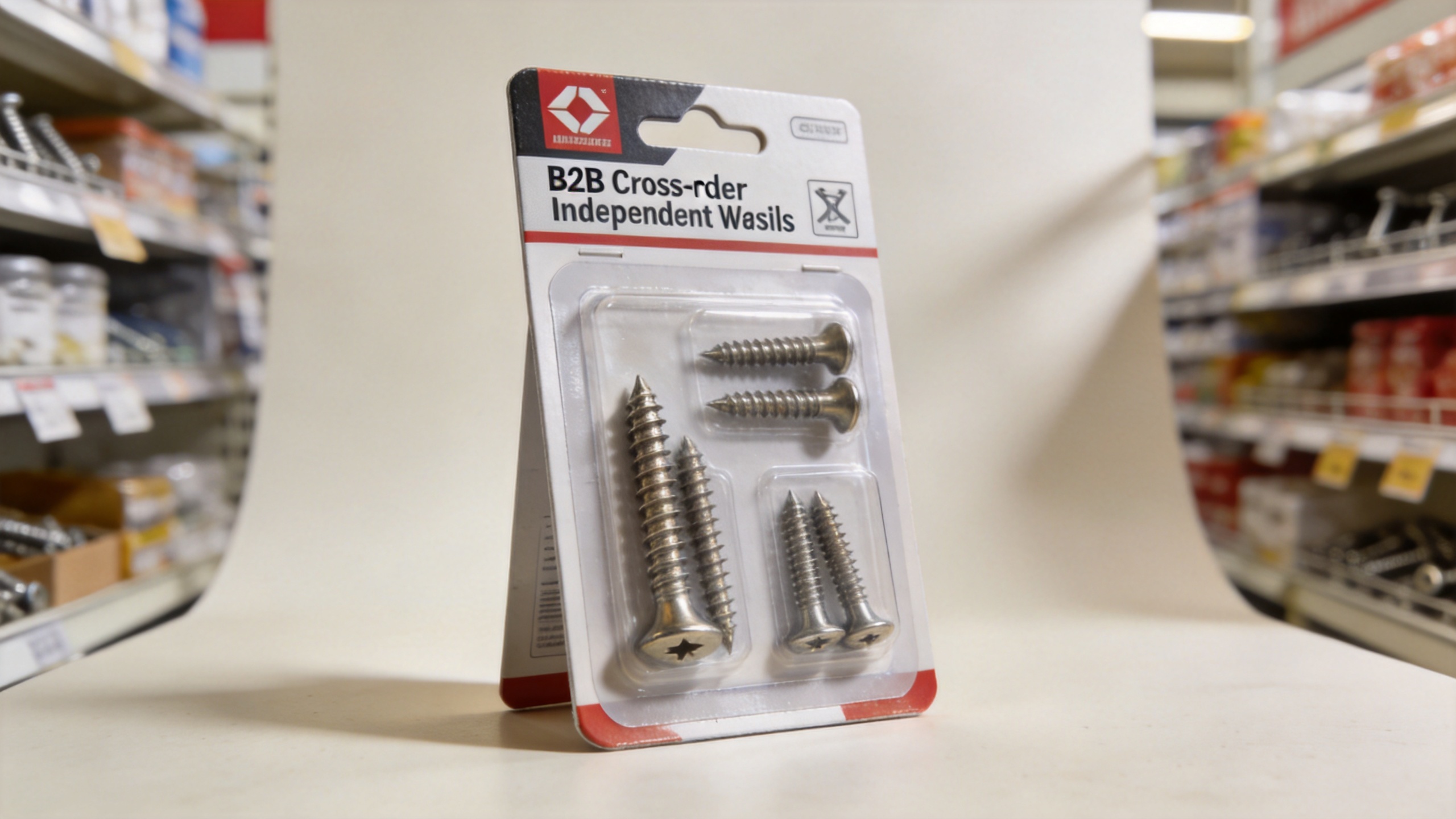
For hardware and fastener products going to supermarket chains or DIY retail, this distinction matters. Shelf-ready packaging — sometimes called retail-ready packaging — is not optional in many modern retail environments. Retailers in Spain, Italy, and Latin American markets increasingly require suppliers to deliver products in packaging that goes directly onto the shelf without additional handling. A supplier who cannot meet this requirement loses the contract, regardless of unit price competitiveness.
There's a second gap that's easy to overlook: the communication cost of OEM customization. High revision cycles, unclear specification handoffs, and insufficient sampling rounds translate into delayed launches and increased total costs. These are systemic problems, and they point to the need for evaluating your supplier's OEM process maturity, not just their catalog.
Core Evaluation Dimensions for OEM Packaging
A business-aligned evaluation framework for OEM packaging should cover at least four dimensions. Depending on your channel, some will carry more weight, but all deserve structured assessment.
Shelf Compatibility and Retail Readiness
For products entering supermarket or mass retail channels, the first filter is whether the supplier can produce shelf-ready OEM packaging that meets your retailer's specific requirements: standard panel sizing, peg hole placement, barcode scannability, and multi-language labeling for Spanish, Italian, or Portuguese-speaking consumers. Check whether the supplier handles these in-house or relies on third-party converters, since the latter increases lead time and limits late-stage revisions.
Customization Depth and Process Maturity
Not all OEM packaging suppliers offer the same depth of customization. Some can only apply your logo and adjust colors. Others support full structural design, material substitution, and market-specific compliance labeling from a single project brief. Ask to walk through a past OEM packaging project end to end: how many revision rounds, what was the sampling turnaround, were there specification changes after final approval. Those answers reveal process maturity more reliably than any sales presentation.
Market Compliance and Channel Access
OEM packaging that doesn't meet target market compliance requirements can't be sold, or worse, gets recalled. For hardware fasteners, this means accurate weight and dimension labeling, material safety declarations, and in some cases CE markings for European markets. Confirm which compliance elements apply in each target market and verify the supplier's prior experience in those regions. Suppliers with established export experience in Spain, Italy, Mexico, or Malaysia are far less likely to surface compliance gaps after production.
Supply Chain Reliability and Volume Flexibility
Packaging availability matters as much as product availability. A supplier who delivers 10,000 units in month one but can't scale to 50,000 for a seasonal peak is a real business risk, not just an operational inconvenience. Evaluate production capacity, factory network depth, and delivery consistency over time. Suppliers with diversified manufacturing partnerships offer a practical buffer against single-point delays — particularly relevant for fastener lines with seasonal demand spikes around home improvement cycles.
Custom vs. Standard: Making the Tradeoff with Business Logic
One of the more frequent decision points in OEM packaging evaluation is whether to invest in fully custom packaging or use a supplier's standard format with your branding applied. There's no universal answer, but there is a useful framework for thinking it through.
Standard OEM packaging with custom branding makes sense when volume falls below the MOQ threshold for a structural custom run, when timelines don't allow a full development cycle, or when retailer requirements are generic enough that standard formats meet the spec. The advantage is speed and lower upfront cost. The tradeoff: if your product looks structurally identical to others on the shelf, your brand carries the full weight of the purchase decision.
Fully custom OEM packaging is justified when entering a channel with specific shelf-ready requirements, when your SKU mix needs a unified visual system, or when a previous line underperformed due to packaging issues. The upfront investment in tooling and sampling is often more cost-effective than a failed channel entry or below-target sell-through.

Aligning Packaging Selection with Your Channel Strategy
A structured OEM packaging evaluation starts with channel requirements and works backward to the specification. Map the distribution journey first: Who handles the packaging between factory and retail shelf? What are the storage and transit conditions? What does the retailer's receiving process look like? These answers define the performance requirements that packaging must meet before brand aesthetics enter the picture.
From there, build a scoring matrix weighted against your specific channel priorities. A buyer supplying a large-format home improvement retailer in Western Europe will prioritize shelf-ready compliance and multi-language labeling. A buyer supplying online marketplaces may weight damage resistance and compact transit dimensions instead. The same supplier can perform very differently against these two criteria sets, which is why generic vendor comparisons rarely hold up in practice.
What to Look for in an OEM Packaging Partner
For hardware fasteners specifically, the most valuable OEM packaging partners understand both the product category and the retail environment: weight distribution, corrosion sensitivity, the need for anti-rust packaging in humid climates, and how hardware retail operates across target markets.
Look for suppliers who can show shelf-ready delivery with references from comparable retail channels, support multi-market labeling in a single production run, and manage the OEM customization process with a structured brief-to-sample workflow and clear revision tracking. Total project cost is rarely determined by unit price alone.
With over 18 years of export experience in Spain, Italy, Mexico, Chile, and Malaysia, Kuaou Hardware has built its OEM packaging capability around global retail and supermarket channel requirements. With 7,000+ SKUs and 300+ factory partnerships, the platform supports shelf-ready packaging programs at scale, from initial brief through multilingual label design to final delivery.
A Framework, Not a Formula
OEM packaging evaluation is not a checkbox exercise. The goal is to select packaging that supports your business goals: channel entry, shelf performance, brand equity, and supply chain reliability. Buyers who work through a structured evaluation framework consistently make better decisions than those who optimize for price alone. Build your process around channel requirements, weight your criteria honestly, and the right OEM packaging choice becomes clearer.
 Hot News