 EN
Cup Hooks Versus Pegboards: Storage Solutions Analyzed
A cup hook and a pegboard solve the same broad problem: getting useful things off a crowded surface. Their approaches are very different. A cup hook creates one fixed hanging point. A pegboard creates a reconfigurable field of hanging points. The better choice depends less on which looks more organized and more on what you need to store, how often the layout changes, and what the wall or cabinet can safely support.
For a DIY user, the practical test is simple: can you reach the item easily, put it back without fuss, and trust the mounting point? This comparison looks at cup hook storage and pegboard storage through those everyday decisions instead of treating either as the universal winner.
The Short Answer: Choose by Storage Pattern
Choose a cup hook when you have a small number of lightweight items that each need a permanent home: mugs beneath a cabinet, keys by a door, measuring spoons inside a pantry, or a single hand tool on a wood rail. It is compact, inexpensive, and visually quiet. The trade-off is that changing the arrangement means removing and reinstalling hardware.
Choose a pegboard when you need a visible system for many items, especially tools, craft supplies, kitchen accessories, or retail-ready packs that are added, removed, and regrouped. Pegboard accessories can be moved as needs change. The trade-off is a larger installation, more visual presence, and the need to match hooks and accessories to the board format.
| Decision factor | Cup hook | Pegboard |
|---|---|---|
| Suitable use | A few repeat-use, lightweight items | Many items that benefit from flexible grouping |
| Layout changes | Low flexibility; each move leaves a mounting decision | High flexibility; accessories can be repositioned |
| Installation footprint | Small, often one hole per hook | Large panel or rail system with multiple mounting points |
| Visual effect | Minimal and discreet | Open, functional, and more noticeable |
| Planning priority | Substrate, spacing, and item clearance | Panel size, accessory compatibility, and load distribution |
Where a Cup Hook Fits Well
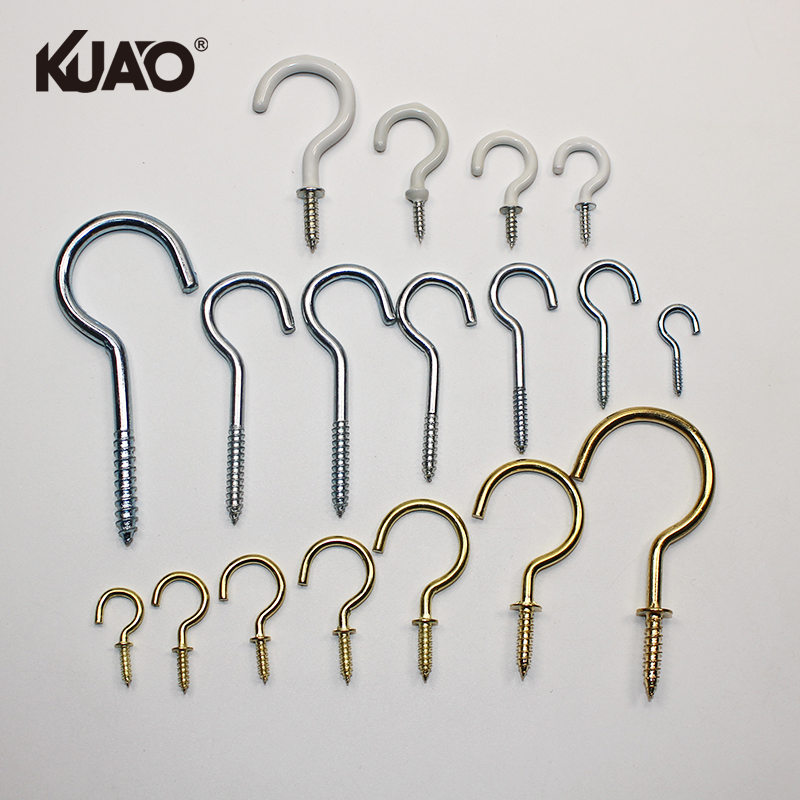
A cup hook is a screw-in hook with a curved open end. Its strength is not high capacity; its strength is precision. It gives one object one predictable place. That is especially useful where storage needs to disappear into the furniture: under shelves, inside cabinet doors, along a narrow timber strip, or on the underside of a kitchen cabinet.
Think about the motion before choosing the hook. A mug needs enough room to lift off without hitting the cabinet face. A key ring needs an open curve that is easy to use one-handed. A utensil needs a hook location away from drawer swings and appliance doors. These small clearance checks matter more than the finish color.
Installation is also part of the decision. In solid wood, locating the hook and using an appropriately sized pilot hole can make the screw-in action smoother and reduce the chance of splitting. In drywall, a cup hook is not automatically a safe answer for a heavy or frequently tugged item; use a mounting method suited to the wall and the expected load. Do not treat a small hook as a substitute for a properly rated anchor or a structural fixing point.
Where Pegboard Has the Advantage
Pegboard earns its space when storage is a changing collection rather than a fixed set. A workshop wall may need a different layout after a new tool purchase. A craft area can shift from paint bottles to sewing tools. A kitchen utility wall can move from pans to baskets as routines change. With a pegboard, the panel stays put while the organization evolves.
Many standard boards use a grid with holes spaced about 1 inch, or 25.4 mm, from center to center. That common pattern is helpful, but it is not a guarantee that every accessory fits every board. Hole diameter, panel thickness, proprietary systems, spacer requirements, and the way a hook locks into place all matter. Check the board and accessory system together before buying a large set of hooks.
The biggest pegboard mistake is to treat the whole panel as equally suitable for every item. A sensible layout puts frequently used, lighter items at eye or hand level, keeps sharp or awkward tools secure, and avoids concentrating too much weight in one small area. If the board sits proud of the wall, plan enough clearance behind it for hook legs and mounting hardware.
Capacity, Safety, and the Wall Behind the Storage
It is tempting to ask which option holds more. The useful comparison is not cup hook versus pegboard in the abstract. It is the complete mounting system in relation to the item and its use pattern. A cup hook in solid wood behaves differently from one in thin fiberboard. A pegboard fixed into studs behaves differently from a panel secured only where the wall material allows.
For light, predictable items, a cup hook is often the more direct solution. For a set of mixed tools or supplies, a pegboard spreads the organization across a larger area and lets you assign different accessories to different shapes. Neither option should carry a load beyond the rating of its hook, fastener, panel, and mounting surface. When the stored item is heavy, valuable, breakable, or pulled repeatedly, verify the manufacturer guidance and choose hardware designed for that task.
Appearance and Everyday Use
Cup hooks suit spaces where you want storage to feel built in. A line of matching hooks can turn an unused cabinet underside into a mug station without changing the room’s visual rhythm. Brass-tone, zinc-tone, painted, or vinyl-coated finishes can support the look, but finish should follow the environment. A damp area needs more thought about corrosion resistance than a dry pantry.
Pegboard makes storage part of the room’s display. That can be a benefit: you can see inventory at a glance and notice when a tool is missing. Yet open storage also asks for discipline. If the wall becomes a random assortment of half-used hooks, the system loses its advantage. Group by task, leave a little growth space, and label bins or zones where several people share the area.
A Practical Selection Checklist
- Count the items. Fewer than a handful of stable items usually favors a cup hook; a growing collection usually favors pegboard.
- Measure the movement. Check lifting clearance, door swings, and elbow room—not just empty wall area.
- Identify the substrate. Wood, masonry, drywall, cabinet board, and metal require different fastening choices.
- Plan for change. If you rearrange tools or supplies seasonally, pegboard flexibility may outweigh its larger footprint.
- Match hardware to the use. A cup hook should suit the item’s shape; a pegboard hook should fit the specific panel system.
- Keep safety proportional. Use suitable anchors or structural fixings where the load or repeated use requires them.
Which Storage Solution Should You Buy?
A cup hook is the better storage solution when the goal is a neat, dedicated place for a small number of lightweight items. It is ideal for mug rails, key stations, utensils, and other repeat-use objects that do not need constant rearranging. A pegboard is better when the goal is an adaptable storage wall for a wider mix of tools, supplies, or accessories.
The most effective spaces often use both. Put cup hooks where the daily routine is fixed, such as under a cabinet or along a narrow rail. Use pegboard where the collection changes and visibility matters. Choosing by behavior—not by trend—creates storage that stays useful after the first week of organizing.
 Hot News