Cast-in-place anchor bolts are positioned within formwork before concrete placement, creating a monolithic connection that avoids the compromises of post-installed systems—no drilling, no adhesive curing delays, and no risk of substrate damage. Precise layout using templates or jigs ensures alignment with base plates and structural steel, and coordination with rebar detailing prevents interference. Embedment depth in normal-weight concrete is typically 8–12 times the bolt diameter to fully develop tensile capacity. Bolts must be securely braced and leveled prior to pour; uncontrolled vibration during consolidation can displace anchors, making careful placement and sequencing essential. Final quality control includes verifying projection above the finished surface and protecting threads from mortar or debris. Field experience shows that inadequate bracing is the leading cause of out-of-tolerance installations—a risk significantly reduced when anchor placement is integrated into reinforcement detailing and pour planning.
ACI 318-19 requires anchor design to explicitly distinguish between cracked and non-cracked concrete conditions. In uncracked concrete, cast-in-place anchor bolts achieve full tensile capacity governed by concrete breakout and pullout resistance. Where cracking is expected—such as in tension zones of slabs, beams, or seismic frames—the code applies a reduction factor (Ψc,N = 0.70 for cracked vs. 1.0 for uncracked), lowering design strength accordingly. Testing confirms that crack formation can reduce breakout capacity by 20–30% compared to uncracked conditions. For this reason, projects in high-seismic zones or where service-induced cracking is anticipated should specify anchors pre-qualified for cracked-concrete performance under ACI 318-19 Chapter 17. This distinction isn’t theoretical—it directly impacts safety margins, connection redundancy, and long-term serviceability.
Seismic applications demand verified cyclic performance—not just static strength. Cast-in-place anchor bolts intended for SDC C–F must undergo rigorous testing per ICC-ES AC193 or European Technical Assessment (ETA) protocols, including simulated crack opening/closing cycles and repeated tension-shear loading. These evaluations confirm ductility, energy absorption, and absence of brittle failure. An ICC-ES Evaluation Service Report (ESR) documents the anchor’s validated capacities—including ultimate and allowable tension and shear values—for both cracked and uncracked concrete, expressed in kips or kN. For example, a 3/4-inch carbon-steel cast-in-place anchor bolt may be rated for 18 kN tension in cracked concrete per its ESR listing. Specifying only anchors with current, code-recognized ESR or ETA documentation provides an auditable, defensible path to compliance—and reflects adherence to modern structural best practices.
Epoxy-set anchor bolts transfer load via chemical adhesion rather than mechanical expansion. After drilling a clean, properly sized hole, two-part epoxy resin is injected and the threaded rod inserted. As the resin cures, it forms a rigid, continuous bond along the entire embedded length—distributing tensile stress uniformly and resisting shear through interfacial adhesion. Because no radial expansion occurs, these anchors impose no stress on the concrete matrix, making them uniquely suitable for cracked concrete and substrates prone to spalling or micro-fracture. The cured epoxy’s controlled flexibility also enhances fatigue resistance under dynamic or vibratory loads. In 4,000 psi concrete, well-installed epoxy anchors routinely exceed 3,000 lbs tensile capacity—outperforming many mechanical alternatives without compromising substrate integrity.
Epoxy anchor performance hinges entirely on execution—not just product selection. Even minor deviations in field practice can compromise bond strength significantly. The table below highlights the most consequential variables:
| Variable | Impact on Bond Strength |
|---|---|
| Hole cleanliness | Dust, oil, or debris reduces effective bond area by up to 50%. Holes must be brushed thoroughly and blown clean with oil-free air. |
| Ambient temperature | Epoxy viscosity and cure kinetics are temperature-dependent. Most formulations require ≥5°C (41°F); colder temperatures delay cure and reduce final strength. |
| Substrate moisture | Surface-dry (SSD) condition is optimal. Standing water displaces resin and creates weak boundary layers. |
| Resin mixing ratio | Incomplete mixing or incorrect ratio prevents full polymerization. Always use manufacturer-supplied static mixers and discard the first 2–3 inches of dispensed resin. |
| Curing time | Premature loading risks permanent deformation or bond failure. Full service load should only be applied after reaching specified hardness—typically 24–72 hours depending on temperature and formulation. |
Product-specific data sheets must govern all installations, and field pull-out verification tests are strongly recommended—especially for critical or high-load applications—to validate as-built performance against design assumptions.
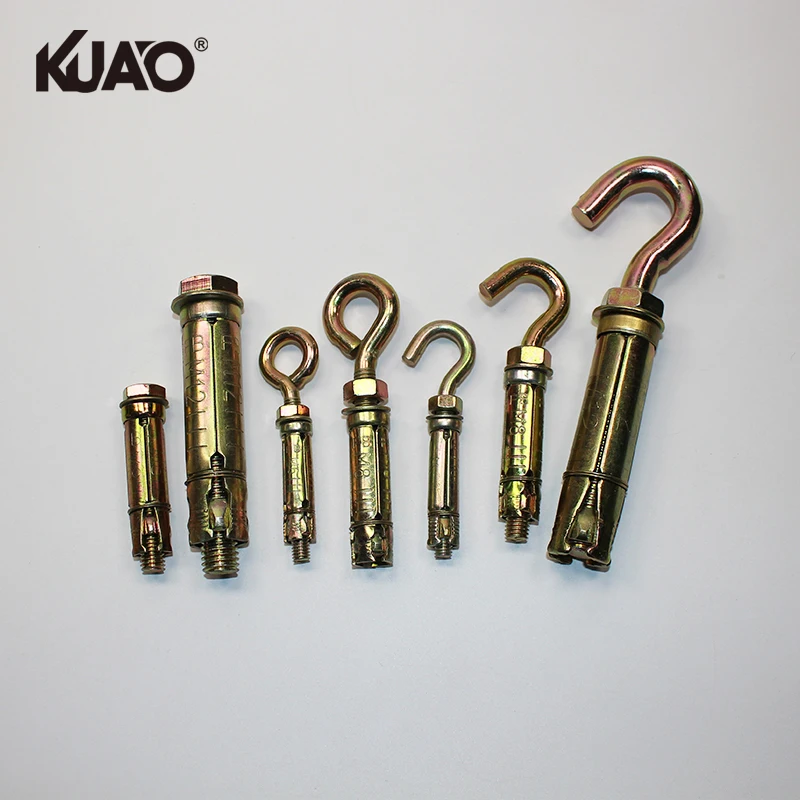
Wedge anchor bolts generate high pull-out resistance by driving a tapered wedge into a split sleeve, expanding it radially against the concrete bore wall. This creates localized point-bearing stresses that deliver strong static tension and shear capacity—e.g., ~2,500 lbs tension and ~3,200 lbs shear for a 1/2-inch diameter anchor, scaling to ~4,800 lbs and ~5,600 lbs respectively for 3/4-inch (per industry load tables). However, their performance is highly sensitive to edge distance: ACI 318-19 specifies a minimum edge distance of 5 anchor diameters to prevent concrete breakout. Closer spacing demands engineering evaluation and may require capacity derating. While wedge anchors are approved for cracked-concrete use in certain seismic-rated systems, their reliance on intact concrete near the anchor head makes them less forgiving than cast-in-place or epoxy alternatives when cracking is expected.
Sleeve anchor bolts rely on uniform radial expansion of a metal sleeve along the embedment length—distributing load more broadly than wedge types and reducing peak stress concentrations. This behavior makes them better suited for lower-strength masonry or variable-density substrates, though they’re most commonly used in medium-duty concrete applications. A typical 1/2-inch sleeve anchor delivers ~1,800 lbs tension and ~2,200 lbs shear—highlighting its shear-dominated profile. Performance scales directly with embedment depth, but excessive depth risks blowout in thin sections. Unlike wedge anchors, sleeve types are less susceptible to edge-distance limitations, yet still require strict adherence to manufacturer-specified hole diameter and embedment tolerances to ensure consistent sleeve expansion and reliable shear transfer.
Choosing the right anchor bolt demands matching technical capability to real-world constraints—not just load magnitude, but also timing, substrate condition, environmental exposure, and code requirements. The three primary categories—cast-in-place, epoxy-set, and mechanical expansion—serve distinct roles in structural and anchoring practice. The following framework distills key decision criteria for engineers and contractors:
| Anchor Type | Typical Load Capacity | Concrete Condition Suitability | Key Advantage | Key Limitation |
|---|---|---|---|---|
| Cast-in-Place | High (tensile & shear) | Cracked and non-cracked | Integral structural strength; no substrate disturbance | Requires pre-planned embedment during concrete pour |
| Epoxy-Set | High (tensile & shear) | Cracked and non-cracked | Exceptional bond strength; post-install heavy loads | Curing time and meticulous hole preparation |
| Wedge Anchor | Medium to high | Best in non-cracked concrete | Quick post-install, high pull-out resistance | Edge distance limits; not ideal for cracked concrete |
| Sleeve Anchor | Medium | Non-cracked concrete preferred | Effective in shear-dominated applications | Sensitive to embedment depth; lower tensile capacity |
Selecting the optimal anchor means evaluating not only what the connection must carry—but how, when, and where it will be installed. Whether anchoring seismic bracing, heavy machinery bases, or façade supports, aligning anchor type with project-specific demands ensures durability, code compliance, and long-term structural reliability.
Cast-in-place anchor bolts are embedded during concrete pouring and form an integral connection, while epoxy-set anchor bolts are installed post-pour using chemical bonding. Both have high tensile and shear strengths but differ in their installation and curing requirements.
Yes, epoxy anchors are particularly suitable for cracked concrete due to their chemical adhesion mechanism that doesn’t stress the concrete matrix.
Poor hole preparation can reduce bond strength by up to 50%, as dust, debris, or moisture can interfere with the epoxy resin forming a secure bond.
Anchor bolts used in seismic applications should have ICC-ES Evaluation Service Reports (ESR) or European Technical Assessments (ETA) confirming their cyclic performance and load ratings.
Sleeve anchor bolts are well-suited for shear-dominated applications in masonry due to their distributed radial expansion mechanism.
 Hot News
2025-12-16
2025-12-11
2025-06-05
2024-11-30
Dongyang Kuaou Hardware Co., Ltd.
Copyright © Dongyang Kuaou Hardware Co., Ltd. - Privacy policy

 EN
EN