 EN
EN
Rivet vs. Bolt Solutions: Evaluating Key Differences
Choosing a rivet or a bolt is not a matter of which fastener is universally stronger. It is a question of what the joint must do after installation. A rivet creates a permanent mechanical joint, while a bolt creates a joint that can normally be released and reassembled. That single distinction affects access requirements, maintenance plans, material selection, inspection, and total assembly effort.
From a fastening-engineering viewpoint, the useful starting point is the load path and service condition—not the catalog name. Thin sheet, one-sided access, vibration, corrosion, and future disassembly all change the answer.
Rivet vs. bolt at a glance
| Decision point | Rivet | Bolt |
|---|---|---|
| Joint type | Permanent after setting | Removable with access to the nut or threaded feature |
| Typical strength focus | Often effective in shear-oriented sheet joints | Often selected where clamp load and tension matter |
| Installation access | Blind rivets can be set from one side | Usually needs nut-side access unless a threaded insert is used |
| Thin material | Can avoid tapping a thread into thin sheet | May need a nut, insert, or a different joint design |
| Maintenance | Removal generally destroys the fastener | Can be removed for inspection or replacement |
When a rivet is the practical choice
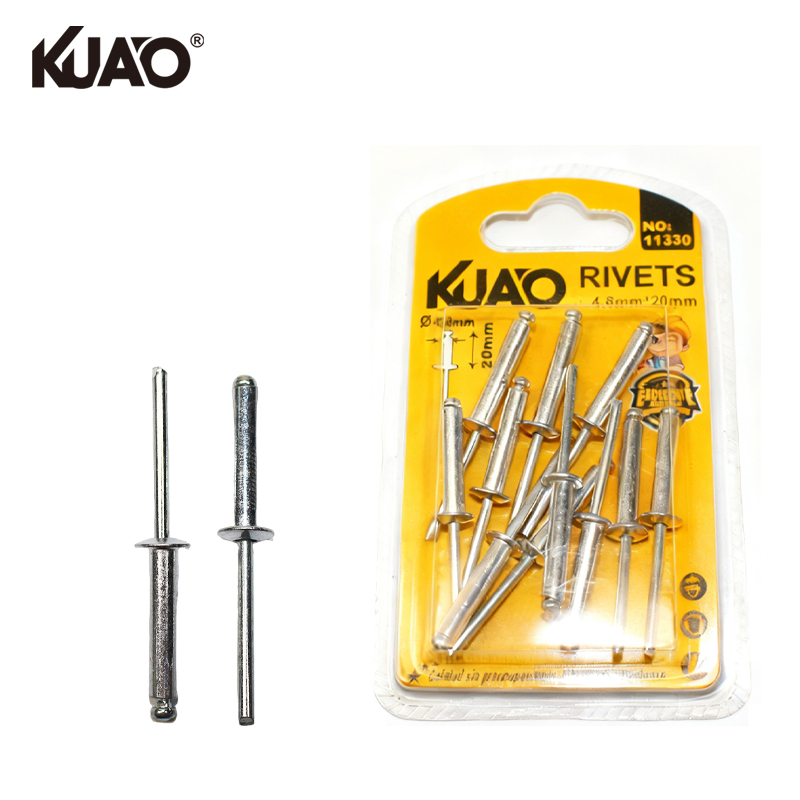
A rivet is often a good fit when the assembly should remain closed for its intended life. Sheet-metal housings, ducts, brackets, appliance panels, and lightweight fabricated parts are common examples. Blind rivets are especially helpful when only the outer face can be reached. The mandrel is pulled to form the blind-side head, so the installer does not need a hand behind the workpiece.
That does not mean every rivet is interchangeable. Grip range must match the combined material thickness; hole size, head style, rivet body material, and corrosion compatibility all matter. A rivet set outside its specified grip range may not form a reliable blind head. In a wet or dissimilar-metal environment, the rivet body and the joined materials should also be reviewed as a system.
For a shear-loaded lap joint, a rivet can distribute the decision around a simple, repeatable installation process. The useful question is not “which rivet is universally suitable?” but “is this rivet appropriate for the sheet stack, access condition, and expected load?” That change in question usually makes selection clearer.
When a bolt is the better solution
Choose a bolt when the assembly must be opened, adjusted, serviced, or replaced. Bolted joints are common in machinery guards, structural brackets, flanges, equipment frames, and assemblies where parts may be swapped during the product life cycle. With a nut or a suitable threaded feature, a bolt creates clamp load between components. This makes it a natural option when joint separation and tension demand must be evaluated carefully.
However, a bolt is not automatically the more durable choice. Thread engagement, tightening method, washer use, joint stiffness, and vibration control are all part of the design. A poorly controlled bolted joint can lose clamp load; a bolt that is difficult to access can turn routine service into a costly operation. Where vibration is expected, the fastening design should consider the full locking method rather than relying on a generic “tighten it more” approach.
Compare the loads before comparing the fasteners
Industry guidance commonly summarizes the difference this way: rivets suit permanent, shear-resistant joints, while bolts provide adjustable joints and are often chosen where tension and clamp load are important. It is a helpful starting point, not a substitute for engineering calculations. Actual capacity depends on fastener diameter, grade or alloy, joint geometry, edge distance, hole quality, material thickness, and the relevant design standard.
- Shear: parts slide across the fastener axis. A rivet may be a straightforward candidate in a thin-sheet lap joint.
- Tension: parts try to pull apart along the fastener axis. A bolted joint may offer the clamp-load strategy the application needs.
- Combined or cyclic load: assess fatigue, vibration, joint movement, and installation consistency before choosing either option.
It sounds safer to pick the largest bolt available, but size alone is not a design method. In thin sheet, an oversized hole can weaken the surrounding material. Likewise, adding more rivets without considering spacing and edge distance can create a weak pattern rather than a stronger joint.
Installation and production trade-offs
A rivet can simplify a production step where one-sided access is valuable. Pop-rivet tools are fast for suitable blind-rivet applications, and there is no separate nut to manage. That can be attractive for enclosed parts or high-repeat assembly. The trade-off is permanence: removal usually means drilling out the rivet and replacing it.
Bolts bring flexibility. They support staged assembly, inspection, and field repair, but they may require more handling and controlled tightening. For procurement teams, total cost should include the installation method, not just piece price. A low-cost fastener that requires awkward access, rework, or frequent inspection can be less economical than a more suitable option.
Material and environment still decide the outcome
Both fasteners must be matched to the joined materials and the exposure. Carbon steel, stainless steel, aluminum, and coated options behave differently in corrosion-prone environments. Joining dissimilar metals can introduce galvanic-corrosion concerns when moisture is present. Coatings, isolation methods, drainage, and the application environment should be reviewed together. This is another point where a rivet-versus-bolt comparison must stay conditional: the right material combination can matter more than the fastening style itself.
Rivet installation checks that prevent rework
Before setting a rivet, confirm the hole is round, clean, and within the fastener maker’s stated range. The rivet head must sit on the intended face, and the blind-side formation must have room to develop. After setting each rivet, inspect head seating and consistency rather than assuming a pulled mandrel proves the joint is acceptable. For repeated work, a simple sample check of the rivet process can identify drift in tooling or hole preparation early.
How to specify a rivet correctly
When a rivet is selected, the purchase specification should state the rivet type, body material, head style, diameter, grip range, and compatible setting tool. A blind rivet also needs an appropriate mandrel style. For critical work, document the hole preparation and inspection method. That level of detail prevents a suitable rivet design from becoming an inconsistent assembly result.
A short selection checklist
- Decide whether the joint must be permanent or serviceable.
- Map shear, tension, vibration, and fatigue demands.
- Confirm whether both sides of the assembly are accessible.
- Measure material stack thickness and available edge distance.
- Check corrosion compatibility between the fastener, joined materials, and environment.
- Define installation controls and the inspection or removal method.
Conclusion
A suitable rivet solution is usually a permanent, access-limited, sheet-metal joint with an installation process that can be repeated consistently. A suitable bolt solution is usually a joint that needs clamp load, future service, or adjustment. Start with the joint’s function, then validate the selected fastener against load, geometry, materials, and the applicable engineering requirements. For sourcing projects, Dongyang Kuaou Hardware can help buyers compare fastener categories and packaging options across a broad inventory, while the final technical choice should remain tied to the specific application.
 Hot News